Odoo Implementation Cost in Saudi Arabia: The Complete 2026 Guide
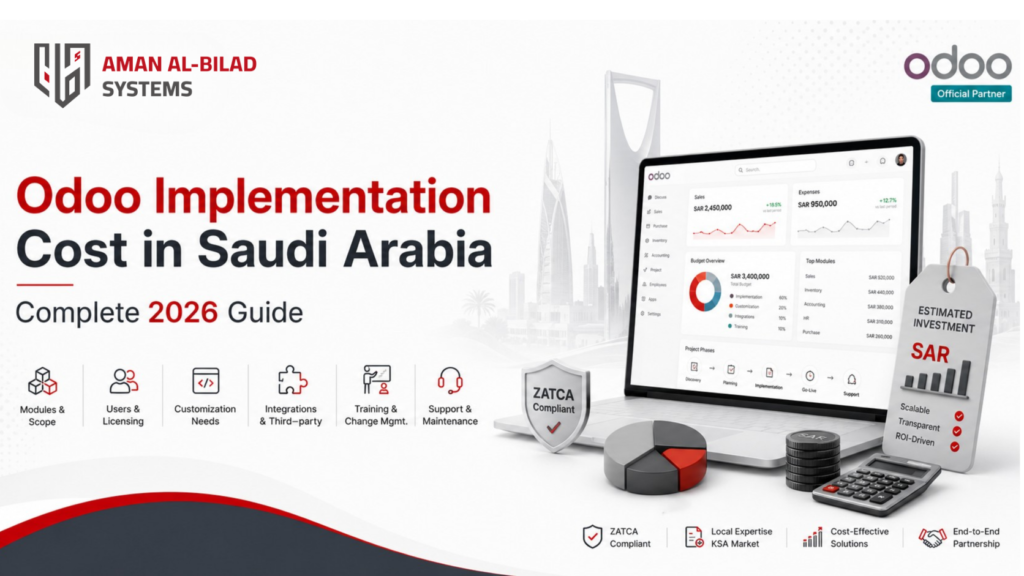
Odoo implementation cost in Saudi Arabia is one of the first questions companies ask when planning an ERP project. However, there is no fixed cost that applies to all organizations. The needs of a small trading company relying on basic accounting and sales are completely different from the needs of a multi-branch retail company, a contracting group, a manufacturing facility, or a large enterprise that requires complex approval workflows, technical integrations, and local compliance requirements.
The actual cost of implementing Odoo depends on the number of users, required modules, complexity of business processes, level of customization, volume of data migration, integrations with external systems, compliance requirements in the Kingdom, as well as training and post-go-live support. This guide explains how to estimate the cost of Odoo ERP implementation in Saudi Arabia, what should be included in the quotation, the hidden costs to watch for, and how to reduce the budget without exposing the project to long-term operational or technical risks.
How Much Does Odoo Implementation Cost in Saudi Arabia?
Odoo implementation cost in Saudi Arabia depends on the size of the organization, selected modules, number of users, customization, integrations, data migration, training, and support scope.
A basic implementation may start from SAR 15,000 to SAR 50,000, while multi-module SME projects usually range between SAR 50,000 and SAR 150,000. Larger projects, or multi-company and multi-branch implementations, may exceed SAR 150,000 to SAR 300,000 or more depending on the level of complexity.
These ranges are general estimates for planning purposes only. They are not fixed prices or binding quotations. The final price can only be confirmed after discovery, process mapping, module selection, compliance requirement review, and technical assessment.
Why Is There No Fixed Cost for Odoo Implementation?
Odoo is a flexible and scalable ERP platform. This flexibility is one of its main advantages, but it also means that cost depends on how the system is implemented and the actual project scope. Two companies may request the same system by name, yet the scope of work can vary significantly.
One company may need only CRM, sales, accounting, and inventory modules. Another company may need POS, eCommerce, manufacturing, HR, payroll, projects, approvals, dashboards, and custom reports. A third organization may require Odoo integration with websites, mobile applications, payment gateways, ZATCA-compliant e-invoicing solutions, logistics platforms, or other external systems.
Since business processes differ from one organization to another, the cost should be calculated based on the project scope, not licenses alone. A professional quotation should clearly separate licensing, implementation, customization, data migration, integrations, training, hosting, and support costs.
Odoo License Cost vs Implementation Cost
Some companies confuse Odoo license cost with implementation cost, although each covers a different scope.
| Cost Type | What It Means | Why It Matters |
| Odoo License Cost | The subscription or software cost based on the selected Odoo plan, number of users, hosting option, and apps used. | It gives the company the right to use Odoo software, but it does not automatically configure the system to match real business processes. |
| Implementation Cost | The cost of professional services that include discovery, configuration, data migration, testing, training, and go-live support. | It transforms Odoo from standard software into a usable business system inside the organization. |
| Customization Cost | The cost of developing workflows, reports, modules, approvals, or operational rules specific to the organization. | It is required when standard Odoo settings do not sufficiently cover the operational need. |
| Integration Cost | The cost of connecting Odoo with external systems such as payment gateways, websites, mobile apps, CRM systems, logistics services, or government platforms. | It reduces disconnected systems and repeated manual entry, and supports more reliable data flow. |
| Support Cost | The cost of ongoing maintenance, issue handling, improvements, monitoring, and user support. | It maintains system stability after go-live and supports continuous improvement. |
Odoo’s official pricing structure covers software subscription plans and may include hosting, support, and maintenance depending on the selected plan. However, implementation services, custom development, data migration, integrations, and aligning the system with local business processes usually require separate planning and pricing.
Main Factors Affecting Odoo Implementation Cost in Saudi Arabia
1. Number of Users
The number of users affects licensing, training, access permissions, roles, approval workflows, and support effort. Setting up a system for five users is much simpler than an implementation covering one hundred users distributed across multiple departments and branches.
2. Required Odoo Modules
Cost increases as the number of modules included in the scope increases. Common modules include Accounting, Sales, CRM, Inventory, Purchase, POS, eCommerce, HR, Payroll, Projects, Manufacturing, Maintenance, Helpdesk, and Fleet Management. Each module requires configuration, testing, training, and alignment with business processes.
3. Business Process Complexity
Organizations with simple operations can rely on standard workflows with limited configuration. More complex organizations may require multiple approval levels, company and branch rules, branch-based permissions, budget controls, automated alerts, document flows, and advanced management reports.
4. Customization Requirements
Odoo customization may be necessary in some cases, but it must be controlled. Workflows, reports, dashboards, fields, approval rules, invoice formats, portals, and custom modules increase the cost. Unplanned customization also increases future maintenance and upgrade costs.
5. Data Migration
Moving data from Excel, legacy ERP systems, accounting software, POS systems, or custom software requires cleaning, field mapping, verification, import testing, and balance reconciliation. Poor data quality is one of the most common reasons ERP project costs increase.
6. Third-Party Integrations
Integration with payment gateways, eCommerce platforms, delivery systems, mobile applications, websites, CRM tools, BI dashboards, HR systems, or government platforms requires API planning, testing, error handling, and monitoring mechanisms.
7. Compliance Requirements in Saudi Arabia
Companies in the Kingdom usually need VAT handling, invoices aligned with ZATCA requirements, Arabic and English document formats, audit logs, approval controls, and multi-company reporting. They may also need HR and payroll localization depending on project scope. These requirements should be identified before pricing the implementation.
8. Training and Change Management
Training affects cost, but it also determines the level of system adoption. Without proper training, users may continue relying on Excel and manual processes, reducing the return on ERP investment.
9. Support and Maintenance
Post-go-live support is essential for resolving issues, responding to user questions, improving configurations, monitoring performance, and gradually enhancing the system.
Estimated Odoo Implementation Cost by Organization Size
The following table provides practical budget ranges for companies in Saudi Arabia. These are not fixed prices, but initial estimates that help understand the expected investment level before conducting detailed discovery.
| Organization Type | Typical Scope | Estimated Implementation Cost |
| Small organization or basic setup | Accounting, sales, CRM, basic inventory, limited number of users, standard reports, and limited customization. | SAR 15,000 to SAR 50,000 |
| Small or medium organization with multiple modules | Accounting, sales, purchase, inventory, HR, approvals, reports, basic integrations, and user training. | SAR 50,000 to SAR 150,000 |
| Advanced mid-sized organization | Multiple departments, multiple branches, advanced workflows, data migration, dashboards, integrations, and extended testing. | SAR 150,000 to SAR 300,000 or more |
| Large enterprise or multi-company environment | Multiple companies, complex approvals, compliance, integrations, custom modules, governance, and support framework. | Custom quotation |
What Is Usually Included in an Odoo Implementation Quote?
A professional Odoo implementation quotation should not be limited to one total figure. It should clarify what is included, what is excluded, and what will be treated as a change request.
- A clear quotation usually includes the following elements:
- Business discovery and requirements analysis.
- Business process mapping and selection of suitable Odoo modules.
- System configuration and setup.
- User roles, permissions, and approval workflows.
- Data migration planning and import support.
- Reports, dashboards, and document templates.
- Testing, validation, and UAT support.
- Training for key users and end users.
- Go-live planning, deployment, and launch support.
- Post-go-live support period and SLA details.
If the quotation does not clearly define the scope, deliverables, timeline, and support, the project may appear less expensive at the beginning, but it may become more costly during implementation or after go-live.
Hidden Costs Saudi Companies Should Watch For
The cheapest Odoo implementation quotation is not always the lowest cost in the long term. Many ERP projects exceed their budgets because important elements were not discussed within the initial scope.
| Hidden Cost | Why It Happens | How to Avoid It |
| Unclear requirements | Starting the project before processes are properly mapped and approved. | Complete the discovery phase and approve the scope before development starts. |
| Poor data quality | Legacy data contains duplicates, missing fields, incorrect balances, or inconsistent product records. | Clean and validate data before migration. |
| Excessive customization | Customizing the system for every small preference instead of using best practices and standard workflows. | Limit customization to requirements that deliver real operational value. |
| Missing integration scope | API requirements are discovered after implementation has already started. | List all external systems before approving the final quotation. |
| Insufficient testing | Users discover issues after go-live instead of during the UAT phase. | Prepare clear test scenarios and formal approval stages. |
| No training plan | Users do not know the correct way to use the system. | Include role-based training, user guides, and operational documentation. |
| No post-go-live support | Issues appear after launch without support included in the project. | Clearly define support duration and SLA in the quotation. |
How Do Compliance Requirements in Saudi Arabia Affect Cost?
Saudi companies should evaluate compliance requirements before estimating Odoo cost. Regulatory requirements may affect accounting setup, invoice formats, reports, approvals, access permissions, audit logs, and integrations.
Potential requirements include:
- ZATCA e-invoicing requirements and tax invoice formats.
- VAT reports and financial documents.
- Arabic and English document templates.
- Branch, department, and multi-company reporting.
- Role-based permissions and approval controls.
- Audit logs for financial and operational transactions.
- HR, payroll, attendance, or local localization requirements when HR modules are included.
- For organizations operating in the Kingdom, compliance should not be treated as a later add-on. It should be included in the implementation blueprint from the beginning.
How to Reduce Odoo Implementation Cost Without Creating Risk
Controlling cost does not mean choosing the cheapest implementer. It means defining the right scope, using standard features as much as possible, and avoiding unnecessary customization.
- Start with a clear discovery workshop before implementation begins.
- Prioritize essential modules for phase one and move optional features to phase two.
- Use standard Odoo workflows when they fit business processes.
- Avoid excessive customization unless it supports a real operational need.
- Prepare and clean master data before migration.
- Clearly define all integrations before approving the quotation.
- Train key users well so they can lead adoption inside the organization.
- Choose an implementation partner who documents configurations and custom development.
Questions to Ask Before Accepting an Odoo Quote
Before choosing an Odoo implementation partner in Saudi Arabia, ask the following questions:
- Does the quotation include discovery and business process mapping?
- Which Odoo modules are included in the scope?
- Are licensing, implementation, customization, hosting, and support costs clearly separated?
- Are ZATCA and VAT requirements included or priced separately?
- How many reports and dashboards are included?
- Does the quote include data migration? How many data templates and import tests does it include?
- Are integrations clearly scoped and priced, or will they be estimated separately?
- What training is included for admin users and end users?
- Does the project include post-go-live support? What is the duration?
- Will custom development be documented in a way that supports future upgrades?
- What happens if requirements change during implementation?
Why Low-Cost Odoo Implementation May Become More Expensive Later
A low-cost quotation may look attractive, but it can create long-term risks if the project lacks documentation, testing, security controls, and proper technical architecture.
- Common issues include:
- Workflow failures.
- Unstable custom modules.
- Duplicate data.
- Weak reporting.
- Poor permission configuration.
- Unsupported integrations.
- Difficulty upgrading the system in the future.
For Saudi companies, Odoo implementation should be treated as a business transformation project, not just software installation. The goal is not only to reach go-live, but to build a reliable ERP foundation that supports finance, operations, compliance, reporting, and future growth.
Why Choose Aman Al Bilad Systems for Odoo Implementation?
Aman Al Bilad Systems helps organizations in Saudi Arabia and the GCC plan, implement, customize, integrate, and support Odoo ERP through a structured delivery methodology.
The focus is not limited to software setup. It extends to governance-led implementation that protects scalability, performance, compliance, and long-term maintainability.
Our methodology includes:
- Structured business discovery and accurate requirements mapping.
- Odoo ERP implementation aligned with real business processes.
- Understanding of Saudi market requirements, including ZATCA, VAT, Arabic and English operations, and approval controls.
- Controlled customization designed for maintainability and upgrade readiness.
- Secure API integrations with websites, mobile apps, payment gateways, and external platforms.
- User training, documentation, go-live support, and continuous improvement.
If your organization is planning an Odoo ERP project, the best first step is to conduct a structured assessment. This helps define the scope, estimate the budget, reduce risk, and build a clear implementation roadmap.
FAQs About Odoo Implementation Cost in Saudi Arabia
How much does Odoo implementation cost in Saudi Arabia?
Odoo implementation cost in Saudi Arabia varies depending on the number of users, modules, customization, integrations, data migration, training, support, and compliance requirements. A basic setup may start from SAR 15,000 to SAR 50,000, while SME and larger enterprise projects may range between SAR 50,000 and SAR 300,000 or more, or require a custom quotation.
Does implementation cost include Odoo license fees?
Not always. License cost is usually separate from implementation cost. Licensing covers access to the software, while implementation cost covers configuration, process mapping, data migration, testing, training, and go-live support.
What factors have the biggest impact on Odoo ERP implementation price?
The main factors are the number of modules, process complexity, customization level, data migration volume, external integrations, user training, compliance requirements, and support scope.
Is Odoo cheaper than SAP or Microsoft Dynamics?
Odoo may be more cost-effective for many small and medium-sized organizations because of its flexible modular structure and different deployment options. However, total cost depends on implementation scope, customization, support, and business complexity, not only on the system name.
Does Odoo support ZATCA e-invoicing requirements?
Odoo can be configured to support invoicing requirements in Saudi Arabia through suitable settings, localization, compliant modules, or integration with approved e-invoicing solutions. ZATCA-related requirements should be identified and validated during the discovery phase.
How long does Odoo implementation take?
A basic implementation may take a few weeks, while multi-module SME projects usually take two to four months. Complex enterprise projects involving integrations and custom development may require a longer timeline.
Can Odoo implementation cost increase after the project starts?
Yes, cost may increase if the initial scope is unclear, data is not ready, new customizations are added, integrations are discovered late, or users request major workflow changes after approval.
How can Odoo implementation cost be reduced?
Cost can be reduced by defining a clear scope, prioritizing phase-one modules, using standard Odoo workflows where possible, preparing clean data, minimizing unnecessary customization, and selecting an experienced implementation partner with a clear methodology.
Does Odoo cost include hosting and annual support?
That depends on the plan and quotation provided. Hosting may be included in the Odoo subscription or provided through an external provider, while annual support usually requires a separate scope that defines support hours, ticket priority, and response time according to an SLA.
What is the cost difference between Odoo Community and Odoo Enterprise?
Odoo Community is an open-source edition that usually does not include user subscription fees, but it may require separate development, support, and hosting. Odoo Enterprise includes a paid subscription, additional features, and services linked to the selected plan. The total cost of each option should be evaluated according to the organization’s needs.
Can Odoo be implemented in phases?
Yes, phased implementation is often safer and clearer. Phase one starts with the core modules and processes, then additional modules, integrations, and improvements are added in later phases according to priority and budget.
Request an Odoo Implementation Cost Estimate
Are you planning to implement Odoo in Saudi Arabia?
Share your organization’s requirements with Aman Al Bilad Systems, and our team will evaluate the required modules, number of users, workflows, integrations, data migration, compliance needs, and support scope to prepare a structured implementation estimate.