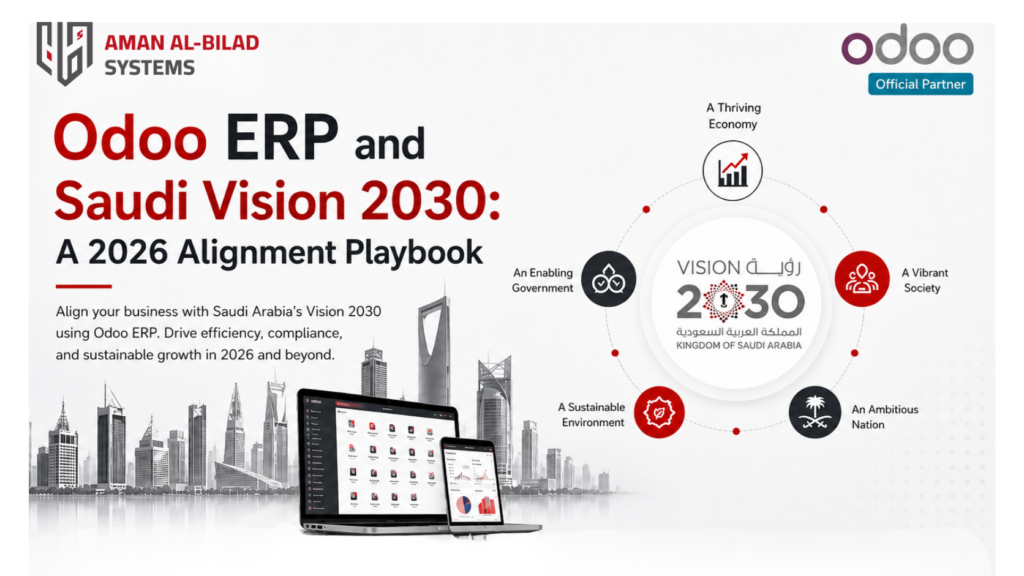
Odoo ERP and Saudi Vision 2030: A 2026 Alignment Playbook
Saudi Arabia’s Vision 2030 is not a future plan anymore it is the present reality every business in the Kingdom must operate within. From ZATCA e-invoicing and Saudisation tracking to IKTVA local-content scoring, the compliance bar has moved significantly between 2016 and 2026. The businesses that are winning are the ones that made their ERP system the backbone of this reporting not an afterthought. Odoo ERP is the platform that Saudi companies, from SMEs to large enterprises, are choosing to get there.
This playbook explains exactly how Odoo ERP aligns with Saudi Vision 2030 goals in 2026 covering digital transformation, ZATCA compliance, Saudisation, IKTVA, and the practical steps your business can take right now.
Understanding Saudi Vision 2030 in 2026
Saudi Vision 2030 was launched to reduce the Kingdom’s dependence on oil and build a diversified, knowledge-based economy. By 2026, it has moved from policy documents into real-time regulatory enforcement. Platforms like Qiwa, Mudad, Fatoora, and HRSD now pull data directly from business systems which means your ERP is either feeding clean compliance data or creating costly gaps.
The key Vision 2030 pillars that affect private businesses directly are: National Industrial Development and Logistics (NIDLP/IKTVA), Human Capability Development and Saudisation (Nitaqat/Qiwa), and Financial Sector Development and Digital Government (ZATCA/DGA). An Odoo ERP implementation in Saudi Arabia, when configured correctly, covers all three from a single platform.
Why Digital Transformation Is Essential for Saudi Businesses
Vision 2030 made digital transformation a survival requirement, not a competitive advantage. Businesses that still rely on disconnected spreadsheets and manual reporting are exposed to ZATCA penalties, Nitaqat tier drops, and IKTVA scoring failures. ERP software Saudi Arabia-wide has become the answer to bridging that gap.
The Digital Government Authority (DGA) benchmarks are clear: real-time data, automated compliance, and integrated business operations are the expected standard. Odoo ERP for businesses in Saudi Arabia delivers exactly this replacing fragmented tools with one system that handles finance, HR, inventory, CRM, and compliance in a unified environment.
What Is Odoo ERP and Why It Matters in 2026
Odoo is an open-source, modular business management software that covers every core business function accounting, HR, payroll, inventory, manufacturing, CRM, project management, and more. It is one of the fastest-growing ERP systems globally and has become the preferred choice for Saudi companies looking for affordable ERP software in Saudi Arabia without sacrificing enterprise-grade capability.
Unlike SAP Business One, Oracle NetSuite, or Microsoft Dynamics 365 which often require expensive customization for Saudi compliance Odoo’s open-source architecture makes it faster and cheaper to localize. It supports ZATCA e-invoicing, Arabic interfaces, GOSI integration, Qiwa data exports, and Mudad WPS payroll out of the box when deployed by a certified Odoo ERP Partner in Saudi Arabia.
How Odoo ERP Aligns with Saudi Vision 2030 Goals
Local Content and IKTVA (Pillar 1: NIDLP)
IKTVA scoring under Aramco and major anchor buyers requires documented local-content data in vendor records, bills of material, and workforce classifications. Odoo’s Purchase, Manufacturing, and Vendor Master modules can carry IKTVA-relevant fields from day one making local-content reporting automatic rather than a spreadsheet exercise at month-end.
Saudisation and Nitaqat Compliance (Pillar 2: Human Capability)
Nitaqat tier Platinum, Green, Yellow, Red is recalculated continuously by HRSD through Qiwa. Odoo HR stores employee nationality, residency type, Qiwa job codes, and contract details in structured fields that produce Nitaqat-readable rosters automatically. Businesses using Odoo ERP in Saudi Arabia see tier risks before HRSD flags them enabling proactive hiring decisions rather than reactive firefighting.
ZATCA E-Invoicing and Financial Compliance (Pillar 3: Digital Government)
ZATCA Phase 2 requires cryptographic stamping, Arabic invoice templates, item-level VAT classification, and real-time XML submission to the Fatoora platform. Odoo ERP and ZATCA compliance are tightly integrated when deployed with the Saudi localization pack a correctly configured Odoo instance achieves 99%+ ZATCA acceptance rates from go-live.
Odoo ERP Features That Support Business Modernization
Unified Business Operations
Odoo consolidates accounting, inventory, HR, CRM, and project management under one data model. There are no data silos, no reconciliation between systems, and no manual hand-offs between departments. This unified structure is what makes Odoo ERP for enterprises in Saudi Arabia a genuine alternative to SAP or Oracle at a fraction of the cost.
Automation and AI Readiness
Odoo ERP automation covers invoice generation, purchase order approvals, payroll runs, inventory reorder triggers, and customer follow-up sequences. The platform is built for AI-assisted workflows with data-driven decision making and real-time reporting replacing the manual reviews that slow Saudi businesses down.
Cloud ERP and Scalability
Odoo is available as Cloud ERP, making it accessible from anywhere and easy to scale as your business grows. Saudi SMEs can start with core modules and add Manufacturing, Project, or E-Commerce as their operations expand without migrating to a new system. This scalability is a key reason Odoo ERP for SMEs in Saudi Arabia has grown significantly in adoption in 2025–2026.
Why Saudi Companies Are Choosing Odoo Over Traditional ERP Systems
The comparison is straightforward when Saudi-specific requirements are factored in. Odoo vs SAP Business One Saudi Arabia: Odoo costs significantly less to license and localize, while covering the same compliance scope. Odoo vs Oracle NetSuite: Odoo’s on-premise and cloud options give Saudi businesses flexibility that NetSuite’s SaaS-only model does not. Odoo vs Microsoft Dynamics 365: Odoo’s open-source base means Saudi customizations IKTVA fields, Qiwa exports, Arabic reports are implemented faster and maintained at lower cost. Odoo vs Zoho ERP: Odoo wins on depth of manufacturing, logistics, and accounting functionality for businesses that need full Vision 2030 compliance coverage.
For businesses looking for the best ERP system for Saudi Arabia in 2026, Odoo consistently scores highest on the combination of cost, localization capability, and Vision 2030 alignment depth.
Odoo ERP for SMEs, Enterprises, and Government Contractors
Odoo ERP for SMEs in Saudi Arabia works best as a phased deployment: compliance core first (ZATCA, Saudisation, payroll), then growth modules (inventory, CRM, purchasing), then reporting overlays (Vision 2030 KPI dashboards, IKTVA score automation). This sequence keeps costs controlled while delivering compliance benefits from week one.
For larger enterprises and government contractors, Odoo ERP for enterprises in Saudi Arabia handles complex manufacturing BOMs with IKTVA tagging, multi-entity accounting with VAT group reporting, and project WBS structures that feed into IKTVA-scored service delivery reporting. The platform scales without a platform migration — the same Odoo core serves a 30-person SME and a 3,000-person enterprise.
Building a Vision 2030-Aligned Business Strategy with Odoo
The four KPIs that Saudi CFOs are now tracking from their Odoo dashboards reflect Vision 2030 directly: local-content share (IKTVA target ≥70%), Nitaqat tier (target: Platinum for strategic activities), ZATCA acceptance rate (target: ≥99% rolling 90-day), and non-oil revenue share (board target: ≥35%). These numbers are only reliable when the underlying Odoo configuration is done correctly with the right fields, integrations, and reporting overlays in place from go-live.
The most common Vision 2030 misalignment in Saudi Odoo deployments comes not from the software but from configuration gaps: vendor records missing IKTVA classification, HR records without Saudisation fields, ZATCA settings left at default, and no single accountable owner for Vision 2030 reporting. Getting these right upfront is the difference between an ERP that helps and one that just creates a new layer of manual work.
How Aman Al Bilad Systems Helps Businesses Achieve Vision 2030 Goals
Aman Al Bilad Systems is a certified Odoo ERP Partner in Saudi Arabia with hands-on experience deploying Odoo for Saudi businesses across sectors including retail, logistics, manufacturing, and services. As an Official Odoo Partner, our team handles end-to-end Odoo ERP Solutions — from initial gap analysis and localization to training, Odoo Support & Maintenance, and Odoo Customization Services built for Saudi regulatory requirements.
We configure Odoo to report against IKTVA, Nitaqat, ZATCA, and DGA requirements from day one — not as an add-on after go-live. Whether you are an SME looking to align with Vision 2030 for the first time or an enterprise looking to replace a legacy ERP, Aman Al Bilad Systems is your implementation partner for the journey.
Frequently Asked Questions
How does Odoo ERP support Saudi Vision 2030?
Odoo ERP supports Vision 2030 by aligning with its three core pillars: IKTVA local-content reporting through Purchase and Manufacturing modules, Saudisation compliance through HR and Qiwa integration, and ZATCA digital compliance through e-invoicing and real-time VAT reporting. When deployed with Saudi localization, Odoo becomes the source-of-truth system that regulators and the board read from.
Is Odoo ERP suitable for Saudi SMEs?
Yes. Odoo ERP for SMEs in Saudi Arabia is one of the most cost-effective paths to Vision 2030 compliance. Its modular structure means SMEs can start with accounting, HR, and ZATCA e-invoicing, then expand into inventory and CRM without replacing the platform. The open-source licensing keeps total cost of ownership significantly lower than SAP or Microsoft Dynamics 365.
Does Odoo ERP support ZATCA e-invoicing?
Yes. Odoo ERP and ZATCA compliance go hand-in-hand when the Saudi localization pack is properly installed and configured. This includes Phase 2 e-invoicing with cryptographic stamping, Arabic invoice templates, item-level VAT classification, and XML submission to the Fatoora platform. A correctly deployed Odoo instance targets a 99%+ ZATCA acceptance rate.
What are the benefits of Odoo ERP for digital transformation?
The benefits of Odoo ERP for digital transformation include: unified business operations with no data silos, real-time reporting and business intelligence, automated workflows across finance, HR, and supply chain, cloud ERP scalability, and native integration with Saudi government platforms (Qiwa, Mudad, Fatoora, GOSI). These capabilities directly address the Digital Government Authority’s digital transformation benchmarks.
Why are Saudi businesses adopting ERP systems in 2026?
Saudi businesses are adopting ERP systems in 2026 because Vision 2030 compliance — ZATCA, Qiwa, IKTVA, Nitaqat — now requires real-time data reporting that disconnected spreadsheets cannot provide. ERP software in Saudi Arabia has shifted from an IT investment to a board-level business decision because the CEO, CFO, and CHRO all depend on it for regulatory standing and competitive scoring.
Can Odoo ERP scale with business growth?
Yes. Odoo’s modular architecture means you start with what you need and expand as you grow — adding Manufacturing, E-Commerce, Project Management, or multi-entity accounting without migrating to a new system. This scalability makes Odoo the best ERP system for Saudi businesses planning growth within the Vision 2030 timeframe.
Is Odoo ERP compliant with Saudi regulations?
Odoo ERP is compliant with Saudi regulations when deployed with the correct localization configuration. This covers ZATCA Phase 2 e-invoicing, VAT reporting, GOSI integration, Qiwa-compatible HR records, Mudad WPS payroll, and Arabic language support. Working with a certified Odoo ERP Partner in Saudi Arabia like Aman Al Bilad Systems ensures the localization is implemented correctly from the start.