What is Odoo ERP System, and How It Works for Small Businesses in Saudi Arabia
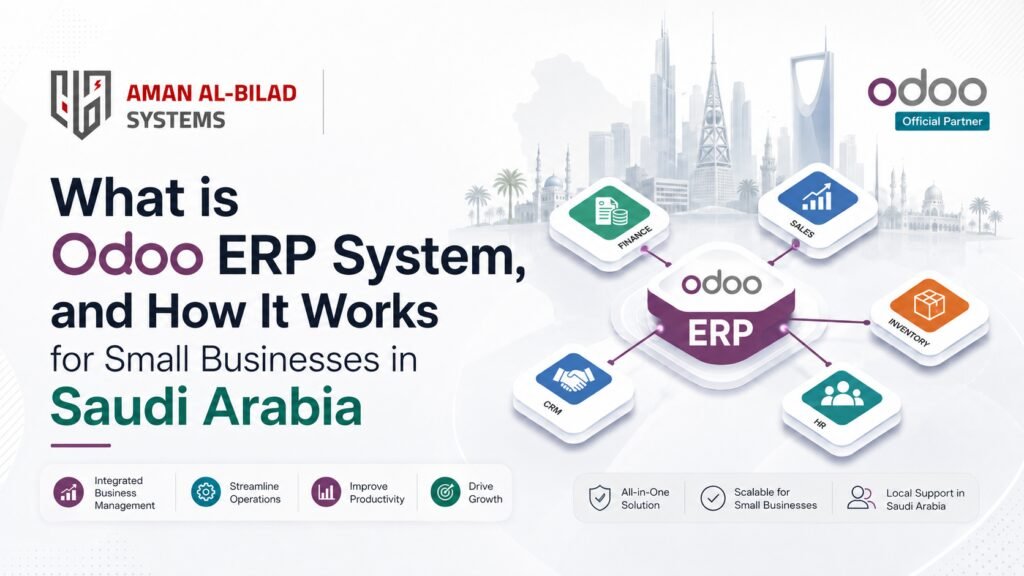
Enterprise Resource Planning, or ERP, is a type of software that helps small businesses bring all their core functions together in one connected system. Odoo ERP integrates accounting, sales, purchasing, inventory, customer management, and human resources in one platform. It reduces manual work, lowers the chances of mistakes, and gives business owners real-time insight into daily operations.
For small businesses in Saudi Arabia, this visibility is critical to scale efficiently without overloading staff. Many growing companies still depend on spreadsheets, separate accounting tools, manual inventory records, and disconnected sales processes. While this may work in the early stage, it becomes difficult to manage as the business grows. Odoo ERP helps small businesses replace scattered systems with a single platform that supports better control, faster reporting, and smoother daily operations.
Understanding ERP and Its Benefits for Small Businesses
An ERP system is more than just software; it is a business management framework that streamlines operations. With Odoo ERP, small businesses can unify processes that were previously scattered across spreadsheets or separate tools. This consolidation leads to better decision-making, improved accuracy, and faster response times.
For example, when a sales order is created in Odoo, it can automatically connect with inventory, invoicing, customer records, and delivery workflows. This reduces repeated data entry and helps teams work with the same updated information. Business owners can see what is selling, which invoices are unpaid, how much stock is available, and how teams are performing without waiting for manual reports.
Odoo ERP also improves productivity by automating repetitive tasks. Instead of manually preparing quotations, invoices, purchase orders, and stock updates, teams can follow structured workflows inside the system. This helps small businesses save time, reduce operational errors, and focus more on customers and growth.
Odoo ERP Modules Overview
Odoo offers a modular approach, which makes it suitable for small businesses that want to start simple and expand gradually. Businesses can begin with essential modules such as Accounting, Sales, Purchase, and Inventory. Once the core modules are running smoothly, additional modules like CRM, eCommerce, Project Management, Manufacturing, Helpdesk, or HR can be introduced step by step.
This phased approach is useful because small businesses do not need to implement everything at once. They can start with the areas that create the most immediate value. For example, a retail business may begin with Sales, POS, Inventory, and Accounting. A service company may start with CRM, Projects, Invoicing, and Timesheets. A trading company may focus first on Purchase, Inventory, Sales, and Finance.
The flexibility of Odoo ERP allows each business to create a system that matches its actual operations. As the company grows, more modules, users, branches, reports, and integrations can be added without replacing the entire platform.
How Odoo ERP Works in Daily Business Operations
Odoo ERP works by connecting different departments through shared data. Instead of each department managing its own separate files, all information is stored and updated in one system. This creates a clear operational flow from customer inquiry to quotation, sales order, delivery, invoicing, payment, and reporting.
For a small business, this means better visibility over every stage of operations. The sales team can track leads and quotations. The inventory team can monitor stock movement. The finance team can manage invoices and payments. The management team can review dashboards and reports to understand performance.
This connected workflow helps business owners make decisions based on real data instead of assumptions. It also improves accountability because every transaction, approval, update, and movement can be tracked inside the system.
Community vs Enterprise Edition
Odoo comes in two editions: Community and Enterprise. The Community edition is free and open-source, but it has limitations in advanced features, official support, hosting flexibility, and enterprise-level capabilities. It can be suitable for very small businesses with simple requirements and technical resources.
The Enterprise edition offers additional features, professional support options, advanced apps, better usability, and more business-ready capabilities. For businesses that anticipate growth or have compliance requirements, the Enterprise edition is often a better long-term choice. Investing in the right edition early can prevent costly migration, rework, or limitations later.
Small businesses should choose the edition based on their budget, growth plans, required modules, reporting needs, hosting preference, and support expectations. A proper consultation before implementation can help avoid choosing the wrong setup.
Successful Odoo ERP Implementation
Implementation success depends on thorough preparation. A small business should start with a detailed needs analysis by engaging with operational staff to identify pain points. This includes understanding how sales are handled, how inventory is tracked, how purchases are approved, how invoices are created, and how reports are prepared.
After the analysis, the next step is module selection and process mapping. This helps decide which Odoo modules are required and how they should be configured. It is important not to over-customize the system in the beginning. A good implementation approach focuses on using standard Odoo features where possible and customizing only where the business truly needs it.
Data migration also requires special attention. Existing customer records, product lists, vendor details, opening balances, inventory data, and employee information should be cleaned and verified before importing into Odoo. Poor data migration can create issues in accounting, reporting, stock management, and customer service.
User training is another important part of successful implementation. Employees should understand how to use Odoo for their daily tasks. Proper training reduces confusion, improves adoption, and helps the business get value from the system faster.
Compliance and Localization in Saudi Arabia
Saudi businesses face specific regulatory and operational requirements. Odoo must be configured for VAT reporting, ZATCA e-invoicing workflows, proper invoice formats, and accurate business documentation from the beginning. For documents in Arabic, businesses may also need right-to-left layouts for invoices, quotations, reports, and customer communication.
Localization is not only about language. It also includes business processes, tax settings, approval workflows, reporting expectations, document formats, and integration requirements. For small businesses in Saudi Arabia, these details are important because incorrect setup can create compliance and reporting challenges later.
Odoo ERP can support Saudi businesses when it is configured correctly with the right modules, workflows, and implementation approach. It also aligns well with the broader digitalization direction in Saudi Arabia, where companies are moving away from manual processes and adopting more connected systems.
Benefits of Odoo ERP for Small Businesses in Saudi Arabia
Odoo ERP provides several benefits for small businesses. It improves efficiency by reducing manual work and repeated data entry. It lowers operational costs by helping teams manage resources, stock, purchases, and sales more effectively. It improves decision-making by giving business owners access to real-time dashboards and reports.
It also improves customer service because customer records, communication history, quotations, invoices, and service requests can be managed from one system. Teams can respond faster and provide better support because they have access to accurate information.
For small businesses planning to grow, scalability is one of the biggest advantages. Odoo allows companies to start with basic modules and expand as the business grows. New users, branches, departments, reports, and integrations can be added over time. This makes Odoo a flexible ERP solution for startups, SMEs, and growing companies in Saudi Arabia.
Why a Local Odoo Implementation Partner Matters
Choosing a knowledgeable local implementation partner in Saudi Arabia is crucial for smooth deployment. A local partner understands Saudi business needs, compliance expectations, Arabic and English workflows, and the practical challenges that small businesses face during ERP adoption.
A professional partner can help with requirement analysis, module selection, configuration, customization, data migration, user training, integrations, testing, go-live, and post-implementation support. This reduces implementation risk and helps ensure the system is aligned with the business from the beginning.
Small businesses should look for a partner that understands both the functional and technical sides of Odoo. The right partner should not only install the system but also guide the business on best practices, process improvement, user adoption, and long-term scalability.
Is Odoo ERP Right for Small Businesses?
Odoo ERP is a strong choice for small businesses that want to organize operations, reduce manual work, and improve visibility. It is especially useful for businesses that are growing, managing multiple departments, handling inventory, preparing invoices, tracking customers, or struggling with disconnected tools.
However, the success of Odoo depends on proper planning and implementation. Businesses should define their goals clearly, choose the right modules, prepare clean data, train users properly, and work with an experienced implementation partner.
For small businesses in Saudi Arabia, Odoo ERP can become a practical foundation for digital growth. It helps connect daily operations, improve control, support compliance, and prepare the business for future expansion.
Frequently Asked Questions
Which is the best ERP system in Saudi Arabia?
The best ERP system in Saudi Arabia depends on the size of the business, industry requirements, budget, compliance needs, and future growth plans. For many small and medium businesses, Odoo ERP is a strong choice because it is flexible, modular, scalable, and cost-effective compared to many traditional ERP platforms. It allows businesses to start with core modules such as accounting, sales, purchase, inventory, and CRM, then expand into HR, eCommerce, manufacturing, projects, and reporting as the company grows. For Saudi businesses, Odoo can also be configured for VAT, ZATCA e-invoicing workflows, Arabic documents, and local operational needs when implemented properly.
What is Odoo ERP used for?
Odoo ERP is used to manage different business functions from one integrated platform. Small businesses use Odoo to handle accounting, invoicing, sales, CRM, purchasing, inventory, HR, project management, eCommerce, POS, reporting, and workflow automation. Instead of using separate tools for each department, Odoo connects daily operations so data flows smoothly between teams. For example, a quotation can become a sales order, update inventory, generate an invoice, and reflect in financial reports without repeated manual entry. This helps businesses reduce errors, save time, improve visibility, and make faster decisions.
What is the salary of an Odoo consultant in Saudi Arabia?
The salary of an Odoo consultant in Saudi Arabia depends on experience, technical skills, functional knowledge, industry expertise, and whether the role is functional, technical, or techno-functional. Junior consultants may earn less, while experienced Odoo functional consultants, developers, or project consultants can earn higher salaries depending on the company and project complexity. In general, Odoo consultants with strong experience in accounting, inventory, CRM, customization, integration, ZATCA workflows, and ERP implementation are more valuable because they can support full business transformation projects.
What ERP system does Aramco use?
Publicly available information shows that Aramco has worked with SAP for enterprise resource planning and digital transformation initiatives. Aramco announced a strategic alliance with SAP Saudi Arabia to expand the digitalization of its ERP systems, and Aramco-related publications have also referenced SAP S/4HANA and cloud migration for ERP transformation. However, large enterprises like Aramco may use multiple platforms and specialized systems across different business units. For small businesses in Saudi Arabia, the key lesson is that ERP adoption is important for improving visibility, automation, compliance, and operational control, whether the system is Odoo, SAP, Oracle, Microsoft Dynamics, or another ERP platform.
Conclusion
Odoo ERP is an integrated business management system that helps small businesses in Saudi Arabia manage accounting, sales, purchasing, inventory, HR, CRM, and reporting from one platform. It works by connecting departments, automating workflows, reducing manual effort, and providing real-time visibility into business performance.
For small businesses, this can lead to better efficiency, improved accuracy, faster decision-making, stronger compliance readiness, and scalable growth. With the right modules, proper implementation, clean data migration, and user training, Odoo ERP can help Saudi businesses move from manual operations to a more structured and digital way of working.