
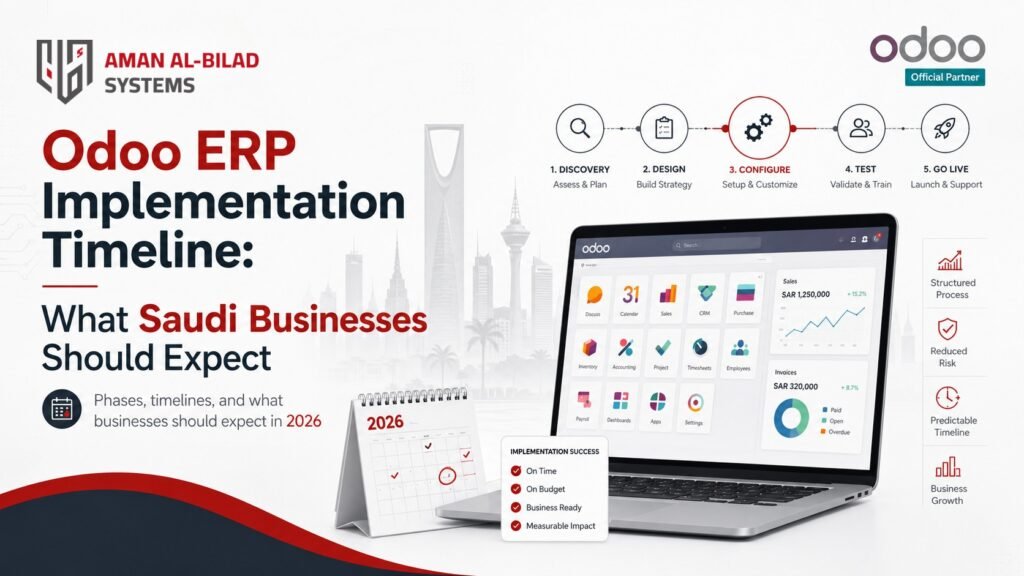
Odoo ERP Implementation Timeline: What Saudi Businesses Should Expect
Implementing Odoo ERP is not just a software installation. For Saudi businesses, it is a structured transformation project that connects finance, sales, inventory, procurement, HR, operations, approvals, reporting, and compliance into one controlled business platform.
The timeline depends on business size, module scope, data quality, customization needs, integrations, user readiness, and local compliance requirements such as ZATCA e-invoicing, VAT configuration, Arabic and English document layouts, and multi-company reporting.
This guide explains how long Odoo implementation typically takes in Saudi Arabia, what happens in each phase, what causes delays, and how to plan a realistic rollout without compromising quality, compliance, or long-term scalability.
Planning an Odoo ERP rollout in Saudi Arabia? Request a structured implementation roadmap from Aman Al Bilad Systems.
| How long does Odoo ERP implementation take? A basic Odoo ERP implementation can take around 6 to 10 weeks, while a small to mid-sized business rollout may require 8 to 20 weeks. More complex Saudi implementations involving multiple modules, integrations, custom approvals, ZATCA requirements, data migration, and multi-company structures may take 4 to 6 months or longer. Enterprise rollouts can extend to 6 to 12+ months depending on scope and governance needs. |
Why Odoo Implementation Timelines Are Not the Same for Every Business
Odoo is modular, which means each company can start with a focused set of applications and expand over time. A retail business implementing Sales, Inventory, Accounting, and POS will not have the same timeline as a manufacturing group implementing MRP, Quality, Maintenance, Purchase, Inventory, Accounting, HR, and custom approvals.
Timeline also depends on how much the business is willing to adapt to standard Odoo workflows. Projects move faster when the company uses Odoo best practices and limits customization. Projects take longer when every legacy workflow is recreated exactly, especially if approvals, reports, integrations, and role permissions are complex.
For Saudi businesses, the timeline must also include compliance validation, Arabic and English formats, invoicing rules, VAT setup, and operational controls that support audit readiness.
Typical Odoo Implementation Timeline by Business Size
| Business Type | Typical Timeline | Common Scope | Notes |
| Basic rollout | 6-10 weeks | CRM, Sales, Accounting, basic configuration | Suitable when processes are simple and data is clean. |
| Small business implementation | 8-12 weeks | 2-3 modules with limited customization | Good for early ERP adoption and controlled go-live. |
| SME multi-module implementation | 12-20 weeks | Sales, Accounting, Inventory, Purchase, HR | Requires stronger testing and user training. |
| Mid-market rollout | 4-6 months | Multiple departments, approvals, reports, integrations | Needs phased delivery and governance. |
| Enterprise / multi-company rollout | 6-12+ months | Multi-entity, custom workflows, integrations, compliance | Best delivered through staged implementation waves. |
Odoo Implementation Timeline by Project Scope
A small scope usually includes standard configuration, limited reports, and a short training cycle. A broader scope includes detailed process mapping, custom workflows, integrations, data migration, advanced reports, testing cycles, and go-live support.
A practical way to plan the project is to separate “must-have for go-live” from “phase two improvements.” This prevents the initial rollout from becoming too large and keeps business teams focused on critical operations first.
| Scope Level | Typical Timeline | Examples |
| Standard configuration | 6-12 weeks | Basic Sales, CRM, Accounting, Inventory setup with minimal changes. |
| Multi-module ERP | 12-20 weeks | Sales, Purchase, Inventory, Accounting, HR, approval workflows, dashboards. |
| Customized ERP | 4-6 months | Custom reports, workflow logic, role-based approvals, custom fields, integrations. |
| Enterprise transformation | 6-12+ months | Multi-company, multiple branches, legacy migration, complex integrations, governance controls. |
Key Phases of an Odoo ERP Implementation
Phase 1 – Discovery and Business Process Mapping
Typical timeline: 1 to 3 weeks
Review current business processes across finance, sales, procurement, inventory, HR, and operations.
Identify pain points, approval requirements, reporting needs, and compliance requirements.
Document the gap between current workflows and standard Odoo capabilities.
Define project scope, priorities, milestones, stakeholders, and go-live objectives.
Phase 2 – Solution Design and Module Planning
Typical timeline: 1 to 3 weeks
Select the Odoo modules required for the first rollout.
Define user roles, access permissions, approval hierarchies, and reporting structure.
Plan integrations with websites, payment gateways, mobile apps, government platforms, or third-party systems.
Prepare a clear roadmap for configuration, customization, migration, testing, and training.
Phase 3 – Configuration and Customization
Typical timeline: 3 to 8+ weeks
Configure Odoo modules based on agreed processes and controls.
Set up companies, branches, chart of accounts, taxes, products, users, workflows, and documents.
Develop custom fields, workflows, reports, dashboards, or modules only where standard Odoo does not meet business needs.
Keep customization upgrade-safe and documented to reduce long-term maintenance risk.
Phase 4 – Data Migration and Validation
Typical timeline: 1 to 4+ weeks
Prepare master data such as customers, vendors, products, employees, opening balances, stock levels, and historical transactions where required.
Clean duplicate, incomplete, or inconsistent records before migration.
Map legacy system fields to Odoo fields and validate migrated data against source records.
Run test migrations before final production migration.
Phase 5 – Integrations and Saudi Compliance Setup
Typical timeline: 2 to 6+ weeks depending on complexity
Configure ZATCA-aligned invoicing and VAT requirements where applicable.
Prepare Arabic and English invoice, quotation, purchase order, and report layouts.
Connect payment gateways, e-commerce platforms, mobile apps, logistics tools, or third-party applications.
Validate APIs, data flows, reconciliation logic, error handling, and access controls.
Phase 6 – Testing and User Acceptance
Typical timeline: 1 to 3 weeks
Perform unit testing, integration testing, and end-to-end process testing.
Validate core scenarios such as lead-to-invoice, purchase-to-pay, inventory movement, payroll or HR workflows, and approval cycles.
Run user acceptance testing with department users before go-live.
Fix gaps before production rollout to avoid operational disruption.
Phase 7 – Training and Change Management
Typical timeline: 1 to 3 weeks
Train users by role, not only by module.
Provide practical workflow training for finance, sales, warehouse, procurement, HR, and management teams.
Prepare user guides, approval instructions, and operational SOPs where required.
Make key users responsible for internal adoption and feedback.
Phase 8 – Go-Live and Hypercare
Typical timeline: 1 to 4 weeks after launch
Move final data to production and validate opening balances, stock, users, permissions, and workflows.
Monitor real transactions during the first days after go-live.
Resolve priority issues quickly through structured support and escalation.
Stabilize the system before starting phase-two enhancements.
Saudi-Specific Factors That Can Affect the Timeline
Odoo implementation in Saudi Arabia often requires more than standard ERP setup. The system must support local compliance, bilingual operations, financial controls, and business practices that may differ from generic global implementations.
These requirements can add time to discovery, configuration, testing, and documentation. They should be planned early rather than treated as last-minute changes.
ZATCA e-invoicing requirements and invoice validation.
VAT configuration, tax reporting, and financial controls.
Arabic and English document layouts for invoices, quotations, purchase orders, and reports.
Multi-company, multi-branch, or GCC-wide operating structures.
Approval workflows for purchases, payments, expenses, HR, projects, and inventory.
Role-based access control, audit trails, and management reporting.
Integrations with payment gateways, e-commerce platforms, websites, mobile apps, or existing legacy systems.
Phased Go-Live vs Full Go-Live: Which Is Better?
For many Saudi businesses, a phased go-live is safer than launching every module at once. It allows the company to stabilize core operations first and then expand into additional modules, automation, integrations, and analytics.
| المؤسسية | Best For | Risk Level |
| Phased go-live | Businesses with multiple departments, limited internal bandwidth, or complex data migration. | Lower risk because modules are launched in controlled waves. |
| Full go-live | Smaller organizations with clean data, limited scope, and simple workflows. | Higher risk if testing, training, or migration is incomplete. |
What Commonly Delays Odoo ERP Implementation?
Unclear scope or changing requirements after development has started.
Poor quality legacy data that requires extensive cleaning.
Too much customization instead of using standard Odoo capabilities.
Slow internal approvals and delayed feedback from key users.
Incomplete testing before go-live.
Integrations with systems that have weak APIs or limited documentation.
Underestimating training and change management.
Leaving ZATCA, Arabic documents, or compliance requirements until the end of the project.
How to Keep Your Odoo Implementation Timeline on Track
Start with a clear discovery phase and approved scope document.
Prioritize core modules required for business continuity.
Use standard Odoo workflows where possible and customize only when necessary.
Assign internal decision-makers who can approve requirements quickly.
Clean and prepare data before migration begins.
Test real business scenarios, not only individual screens.
Train users before go-live and provide support during the first operational cycle.
Use a formal change request process for new requirements.
Questions to Ask Before Starting Your Odoo Implementation
What modules are included in phase one?
What is the expected timeline for each implementation phase?
What responsibilities belong to the client team?
How will data migration be handled and validated?
Are ZATCA, VAT, and Arabic/English formats included in the scope?
Which integrations are included and which are future phases?
How many rounds of user acceptance testing are planned?
What training and documentation will be provided?
What support is included after go-live?
How will changes in scope affect timeline and cost?
Why Work with Aman Al Bilad Systems?
Aman Al Bilad Systems helps Saudi and GCC organizations implement Odoo ERP through a structured, governance-led delivery approach. Our focus is not only to launch modules, but to build a reliable operating system for finance, operations, sales, procurement, HR, reporting, and compliance.
We help businesses define a realistic roadmap, reduce implementation risk, maintain upgrade-safe customization, align financial workflows with Saudi requirements, and support users through go-live and post-launch stabilization.
Structured implementation methodology from discovery to go-live.
Saudi-ready ERP configuration for finance, invoicing, approvals, and reporting.
Upgrade-safe customization and controlled development practices.
Secure integrations with websites, mobile apps, payment gateways, and third-party systems.
Training, documentation, hypercare, and ongoing ERP support.
| Need a realistic Odoo implementation timeline for your business? Request an Odoo implementation roadmap from Aman Al Bilad Systems and get a structured plan based on your modules, users, data, integrations, compliance requirements, and go-live goals. |
FAQs About Odoo ERP Implementation Timeline
How long does Odoo ERP implementation take in Saudi Arabia?
A basic Odoo rollout may take 6 to 10 weeks, while an SME multi-module implementation often takes 12 to 20 weeks. Mid-market projects may take 4 to 6 months, and complex enterprise or multi-company implementations can take 6 to 12+ months.
Can Odoo be implemented in less than 3 months?
Yes, but only when the scope is limited, data is clean, customization is minimal, and decision-making is fast. A focused phase-one implementation can go live faster than a full enterprise rollout.
What causes Odoo implementation delays?
Common delays include unclear scope, poor data quality, excessive customization, slow approvals, incomplete testing, complex integrations, and late compliance requirements.
Is phased implementation better than full go-live?
For most growing businesses, phased implementation is safer because it launches critical modules first and reduces operational risk. Full go-live can work for smaller or simpler implementations.
Does ZATCA compliance affect the timeline?
Yes. ZATCA-related invoicing, VAT setup, document formats, testing, and validation can affect the timeline and should be included early in the implementation plan.
How long does data migration take?
Data migration may take 1 to 4+ weeks depending on data volume, source systems, data quality, cleaning requirements, and validation effort.
How much internal team involvement is required?
Internal involvement is essential. Business users must join discovery sessions, approve workflows, validate data, test real scenarios, attend training, and support go-live adoption.
What happens after Odoo go-live?
After go-live, the project enters a hypercare period where the implementation team monitors transactions, resolves priority issues, supports users, and stabilizes the system before future enhancements.